
When your brain 404s
Turns out overthinking is bad.
I woke up to the sound of my heart pounding in my ears. If you know anything about hearts it’s they usually operate silently, doing the essential business of keeping you alive without you noticing at all. Real (g)hearts keep it silent like lasagna.
Being aware of your heart, especially right out of sleep, isn’t a great sign.
This is a panic attack, I thought. I might have said it out loud. And yet, for a terrible moment I imagined dying alone and clutched my phone. I wish I was joking. Not in case I had to call an ambulance, although that was definitely on my mind, but to have that proxy for human contact at hand. Looking at it, mortality hammering at my synapses, really brought home how much of my life was filtered through its glass display.
This is a panic attack, which means I won’t die. You don’t die from panic attacks. This should be comforting but an unfortunate aspect of panic attacks is, even if you know the signs, and even if you’ve had one before, you can’t know know it isn’t something else. And panic attacks, depending on the flavor, can seem a lot like other really bad things. As a fun bonus, this makes you… panic more!
So I was hugging my phone and taking deep breaths and generally trying to get things under control while the house (me) was on fire, when I thought of having to explain why I, a person almost 50 years of age, had died in his bed because he had self-diagnosed a panic attack. Which of course makes no sense but that’s what I thought. Panic attack!
So I did what any responsible adult would do—I got on my bike and rode to the hospital. Now listen. Listen. In my defense, I wasn’t thinking straight. And also in my defense, I thought it was a panic attack, aka not a life threatening incident. And furthermore I didn’t want to bother anyone with something as frivolous as a medical emergency.
I believe this is what we call the modern condition.
When I got to the hospital the intake nurse asked if I had phoned them. I said no. How did you get here? she wondered. And I, now sensing maybe I’d done something wrong, said I had gotten there by myself (leaving out the bike part). She looked at me the way you might look at a dog with its head stuck in a railing, with a small amount of pity and a healthy amount of concern.
The Dutch healthcare system gets a lot of stick, somewhat deserved, for its, shall we say, emotionally distant treatment of illness. Bad flu? Paracetemol. Unexplained rash? Paracetemol. Femur protruding from your leg? You get the idea.
In the hospital I am met with nothing but diligent care. Diligence is the name of the game. If you come in talking about your heart they will run the full protocol on you, nevermind that you’ve self-diagnosed it as a panic attack. The doctor was almost apologetic. Sorry, but we’re going to take this very seriously and give you expert care.
They’ll do this even though I keep pointing to my left shoulder, a place my heart emphatically isn’t. Anxiety sufferers will know this as the spot where anxiety lives. It feels like your heart is there, but it’s somewhere closer to the middle of your chest.
In the end, I have not had a heart incident. The English translation of the Dutch term is hyperventilation. But I did not hyperventilate, at least not paper bag style. My brain though… maybe my brain hyperventilated.
Over the following days as I tried to figure out why I’d reached that moment I kept coming back to a metaphor around computers. I’d tried to run too many processes and didn’t have enough RAM. My spirit blue screened. And then I rebooted.
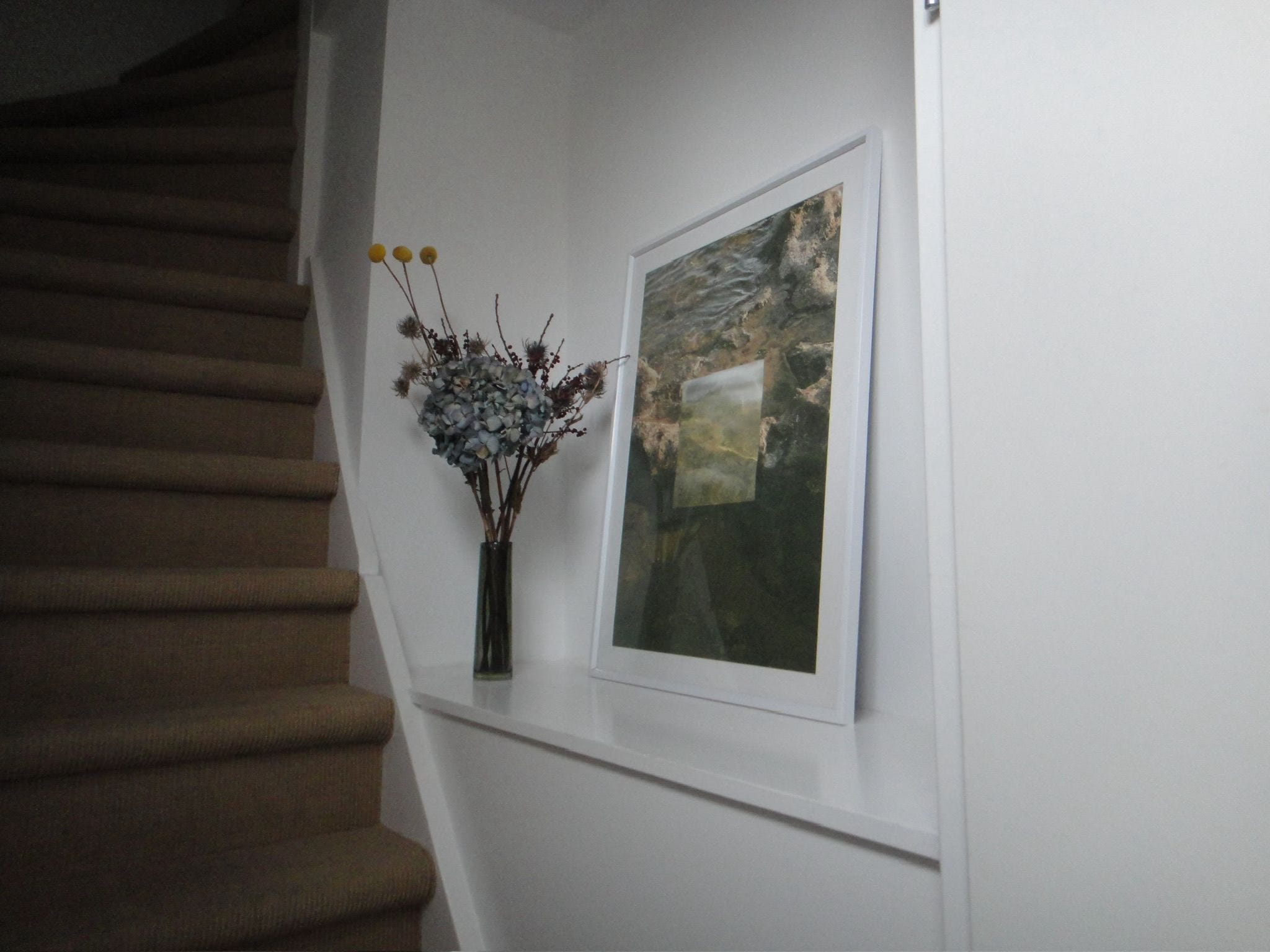
I’ve been rearranging my apartment.
After my hair (which I cut off), my belongings are the most immediate part of me over which I have direct control. Because of this I like to shuffle the apartment layout once every six months, and it’s been at least 2 years since the last grand imagining.
In my dreams there’s a place for everything I own. But here, in the real world, all my stuff is strewn about like the detritus from a shipwreck. I feel like the contents of my home represent the contents of my head.
Multitudinous. Disordered. Slightly abandoned.
When the things I own become overwhelming I give them away. I love giving things away. Sometimes I think I buy things for this very reason.
Can you give away a thought? Is that what therapy ultimately is?
In his book The Case Against Reality, author Donald D. Hoffman floats the theory that our acuity was limited by evolution for caloric reasons (this may be a peer-reviewed fact—there’s a lot going on in that book). Basically when resources were scarce we developed a just-good-enough, MVP version of seeing. And even now that calories are plentiful, we retain this evolutionary holdover.
Thinking isn’t free. Thinking has such an associated cost we developed limiters to ensure we didn’t die while pondering a sunset. I think stress eating is less about comfort than it is about ensuring our bodies don’t devour themselves.1
I used to think I loved thinking. You know that dude who discovers frollicking? That was me and pondering. I loved a reckon. Just add a few prompts like an AI improv class and let it roll! I need a location, a career, and the last five headlines from CNN.
But I think the truth is not as fun. I think I was addicted to thinking. As in, I couldn’t not do it. As in, my thoughts were a step beyond intrusive. They were automatic.
10 years ago, the last time my brain wanted to escape my head, I finally tried meditation, really tried it beyond downloading an app and breathing for a minute. And gol darn it… it worked. I felt better and then things changed, and because I felt better rather than keep it up I stopped.
This was possibly a mistake.
(This isn’t a pitch to get you all to meditate. Although given the state of things… maybe?)
At the time I didn’t really grapple with why I needed to think less, or perhaps, to more accurately describe why meditation works, to think less reflexively. I used to see the way my thoughts could jump from topic to topic, idea to idea, with nary a pause as a good thing. It certainly made school easier. I was always described by teachers as quick. Clever.
The praise I received for it made it almost impossible to give up, and it wasn’t until the walls were crashing down about my ears that it even felt possible. Who was I if not endless thoughts? Who would employ me? Who would love me?
Apparently I never really got past those fears. And when a few things changed in my life, adding a certain list2 to my existence, the thinking returned in earnest. Cascading waves of thought, an endless barrage. I discovered why podcasts have a sleep timer. I even tried a very old trick—praying.
I prayed to whoever might be listening, with the hope they were benevolent and not caught up in specifics. Please, I just want to think less.
After The Incident things mostly returned to normal. Two post checks to confirm my heart was “young and healthy”. Dinner party with homespun karaoke. Five straight days of Amsterdam Dance Event.
When something big happens it always feels weird the world doesn’t just stop. When something big never stops happening, that weird feeling calcifies into a kind of hard certainty the world will never stop again. That things will only keep happening and happening until too many things happen and then we’re gone.

And the only way I know how not only to live with this but somehow remain functional and useful and just good, is to limit the amount of processing my brain is allowed to do. Meditation is good, but I find requiring discipline to master a technique to enable discipline a bit daunting.
So I’ve just been climbing more. The best part about climbing, and there are many best parts, is you literally cannot think of anything else while you’re doing it. You only do that once and discover why you can’t do that and then (if you’re lucky) get to not make that mistake again. The same is true of dancing to certain kinds of music. Really, whatever gets your body engaged quiets the mind.
I don’t know enough to say (see first footnote) if physical meditation is as permanent or helpful as mental meditation, and I’ve not even done a search to see if there’s a distinction between them or if “physical meditation” is even a thing.
But I do know that in These Difficult Times (great band name btw) you do what works and what you’re likely to do again. Once things feel more stable you can quibble with the details.
I’ll leave you with this poem that no matter how many times I read it, it never seems to be enough. I need it grafted onto my DNA. I wish you a pleasant day.
Wait
by Galway Kinnell
Wait, for now.
Distrust everything if you have to.
But trust the hours. Haven’t they
carried you everywhere, up to now?
Personal events will become interesting again.
Hair will become interesting.
Pain will become interesting.
Buds that open out of season will become interesting.
Second-hand gloves will become lovely again;
their memories are what give them
the need for other hands. The desolation
of lovers is the same: that enormous emptiness
carved out of such tiny beings as we are
asks to be filled; the need
for the new love is faithfulness to the old.
Wait.
Don’t go too early.
You’re tired. But everyone’s tired.
But no one is tired enough.
Only wait a little and listen:
music of hair,
music of pain,
music of looms weaving our loves again.
Be there to hear it, it will be the only time,
most of all to hear your whole existence,
rehearsed by the sorrows, play itself into total exhaustion.
I am neither a doctor nor a scientist and my pronouncements must be viewed with absolute suspicion.
Do you know what “listless” means and is it always the opposite of what you think?
...broken heart, Paracetemol.
Wow, great poem - thank you. (Also glad your heart is okay.)